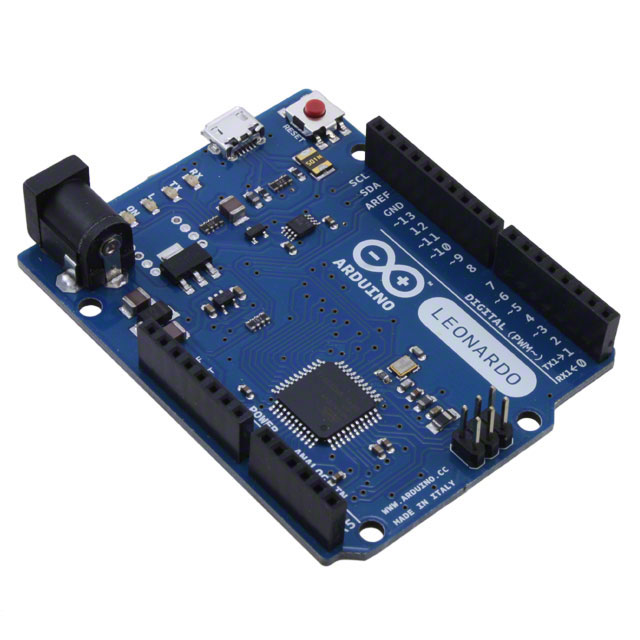
The Arduino Leonardo is a microcontroller board based on the ATmega32u4 (datasheet). It has 20 digital input/output pins (of which 7 can be used as PWM outputs and 12 as analog inputs), a 16 MHz crystal oscillator, a micro USB connection, a power jack, an ICSP header, and a reset button. It contains everything needed to support the microcontroller; simply connect it to a computer with a USB cable or power it with a AC-to-DC adapter or battery to get started.
The Leonardo differs from all preceding boards in that the ATmega32u4 has built-in USB communication, eliminating the need for a secondary processor. This allows the Leonardo to appear to a connected computer as a mouse and keyboard, in addition to a virtual (CDC) serial / COM port. It also has other implications for the behavior of the board; these are detailed on the getting started page.
| Manufacturer | Arduino |
|---|---|
| Category | Open Source MCU Platforms |
| Eval Board Part Number | 1050-1040-ND |
| Eval Board Supplier | Arduino |
| IDE |
Arduino
|
| Speed |
16 MHz
|
| Bits |
8 Bit
|
| Memory, Flash/RAM |
32 kB / 2.5 kB
|
| Digital I/O |
20 I/O, 7 PWM
|
| Interface |
I²C x1
SPI x1 UART x1 USB Device |
| Analog Outputs (DACs) |
7 x 8 Bit
|
| Analog Inputs (ADCs) |
12 x 10 Bit
|
| DMA Channels |
0
|
| Features |
Arduino UNO Form Factor Compatible
Over Current Protection Timers |
| Radio |
-
|
| Interrupt Pins |
5
|
| I/O Voltage |
5 V
|
| Voltage In |
7 ~ 12 V
|
| Touch Sensing Pins |
0
|
| Program/Debug Interface |
ISP Header
USB Type-Micro AB |
| Area |
3658² mm, 5.67² In
|
| Main I.C. Base Part |
ATmega32U4
|
| Design Author |
Arduino
|
| Date Created By Author | |
| Date Added To Library | 2018-07 |











 설정
설정
 빠른 배송
빠른 배송
 무료 배송
무료 배송
 Incoterms
 결제 유형
결제 유형


 Marketplace 제품




 대한민국
대한민국