설정
설정
 빠른 배송
빠른 배송
 무료 배송
무료 배송
 Incoterms
 결제 유형
결제 유형


 Marketplace 제품

Why a Wireless RF Module?
Convergence Promotions LLC 제공
2010-12-22
Wireless connectivity is fast becoming a feature of choice for many applications, today. The ability to cut the wires and mobilize a device is a compelling feature for customers. For the intrepid design engineer, adding wireless to a new or existing product can be a daunting exercise, this article discusses the question of “should I design it, or should I purchase a ready-made, pre-certified module?” Let’s look at the choices and the ramifications of each.

Adding wireless features
Wireless communication involves the electromagnetic spectrum, which has many unique qualities. Radio waves propagate according to the spectrum’s wavelength. Antennas provide an impedance match to the airwaves. There is an abundant selection of wireless devices on the market. The choices of which to use depend upon frequency, modulation and data encoding.
To design or not to design—that is the question. Is it better to design a solution or buy a ready-made, pre-certified module? Wireless ICs range in price from $1 to $5 each, depending upon the quantity and complexity of the device. Design engineers evaluate total system cost—that is to say, all of the components surrounding the IC—if they decide to design a wireless solution themselves. Wireless modules provide a choice of a wireless solution and range in cost from $10 to $100 each, depending upon the quantity and complexity.
At first, the wireless module appears to cost more than the design solution. Let’s take a look at what is behind the system costs.
Test equipment
RF test equipment is valuable whether you choose to design or purchase a module solution.
Either way, you need to be able to see the radio waves and measure quantities and evaluate the performance of a wireless solution.
Table 1 lists the approximate prices for basic RF test equipment. There are many features, accessories, and support equipment surrounding them.
| Spectrum Analyzer | $35,000 |
| Signal Generator | $7,000 |
| Vector Network Analyzer | $45,000 |
| Total | $87,000 |
The spectrum analyzer is a mandatory piece of equipment. It displays frequency versus power. The frequency range should be ten times the fundamental frequency in order to view the 10th harmonic of the device. The FCC certification process will look all the way up to the 10th harmonic.
The vector network analyzer measures the amplitude and phase characteristics of networks. It is a very useful instrument for measuring the characteristics of filters and antennas. A vector network analyzer makes short work of matching circuit impedances—a very common practice in RF. The frequency range should be twice the fundamental frequency so that the second harmonic frequencies can be analyzed. The RF engineer suppresses harmonics in order to pass radio regulations.
If the radio design involves complex signals (OFDM, QPSK), a designer needs to seriously consider a signal analyzer or a signal analysis function in the spectrum analyzer. They should also consider a method to create complex signals from the signal generator. Naturally, this adds to the overall cost of test equipment.
Radio regulations
Radio regulations dictate what a device is permitted to do in a particular frequency band. Regulations differ from country to country and are administered by a government agency. In the United States, that agency is the Federal Communications Commission (FCC). Agencies publish and certify radio devices for operation in their respective countries.
Each country in which an “intentional radiator” (a legal term that means RF transmitter) is sold requires some sort of regulatory certification. This certification requires design engineers to be familiar with radio regulations and how to specify a device’s operation. A fair warning—the radio regulations are written for lawyers, not engineers. Trying to ascertain technical specifications from these can cause a bit of frustration. Even seasoned RF engineers must work closely with compliance test houses for the most current regulatory information and consulting.
Table 2 lists the cost for radio certification in the US, Canada, and Europe. Keep in mind that these costs are for first-time successes. If any retesting is required, additional costs are levied. Remember to book the certification house in advance.
| United States FCC Part 15 | $6,500 |
| Canada: Industry Canada RSS 210 | $6,500* |
| Europe: ETSI | $10,500 |
In the United States, the FCC allows for “modular certification.” This allows companies to create a RF module, certify it for use in the US, and free the integrator of the module from any further intention radiator testing. This is a great boost to the design engineer, as FCC certification is one less thing they have to worry about. And, it is included in the cost of the module.
Decision criteria
Other criteria to consider when choosing whether to design or purchase a module include:
- Reference Designs. Many times, reference designs exist for a wireless solution. With careful implementation, the design can be reproduced and pass certification. However, the responsibility for radio certification falls upon the engineer. If a nuance is overlooked, it could be difficult for the less-experienced RF engineer to find and fix a problem.
- Time-to-Market. A pre-certified RF module will certainly get you to market soonest. But will it be the most economical, over the long run? Consider that an in-house design will take several months to complete, verify, and certify. Twelve to 18 months for a RF design is not uncommon.
- Software Costs. So far we’ve concentrated on the hardware, but wireless solutions require software, as well. As in the case of wireless hardware, there are unique design challenges for the software writer. A simple wireless remote control requires encoding and decoding of the data. A more complicated wireless network, like one using ZigBee technology, requires greater software-writing talent.
Module design
When does a module start to make sense over a discrete design? Given all the costs associated with hiring an engineer, consultant or design house, the cost of test equipment, and the cost of radio regulations certification, the return on investment breaks even only over time and volume. One possibility is starting with a pre-certified RF module, and when the economy of scale presents, treat it as a reference design, transferring the module design to internal production. This requires the company to certify the RF design after bringing the design inside. But, in the long term, it can justify the cost.
It is best to sit down and write a business case comparing the costs of design vs. buy, to find the break-even point. If the volume is relatively low, let’s say 10-20 K units, generally a module is the more economical solution. Above this value, a design becomes more economical.
One example is the MRF24J40MA module from Microchip Technology, shown in Figure 1. This module services the 2.4 GHz unlicensed Industrial, Scientific and Medical (ISM) short-range wireless frequency band for the IEEE 802.15.4™ specification, for ZigBee® or proprietary wireless-protocol systems. It includes discrete biasing components and an integrated PCB antenna to be used in sensor and control network environments. The module is regulatory-agency certified for the US (FCC), Canada (IC) and Europe (ETSI), and saves designers time and money by eliminating the need to receive FCC certification for their wireless products.
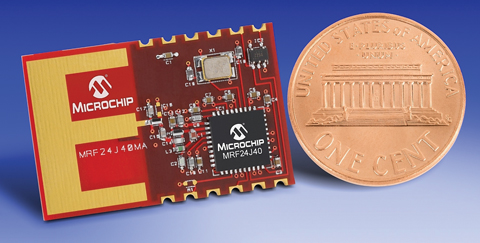
Figure 1: Microchip's MRF24J40MA certified module helps keep development costs low.
Making the callThis article touches on some of the concepts surrounding the decision to design or to buy a wireless module. The bottom line depends upon the priorities that are placed on the project. A certified wireless module will get to market the soonest, with the least expense for a specific quantity. Take the time to weigh the options and make a choice using the above criteria.

면책 조항: 이 웹 사이트에서 여러 작성자 및/또는 포럼 참가자가 명시한 의견, 생각 및 견해는 DigiKey의 의견, 생각 및 견해 또는 DigiKey의 공식 정책과 관련이 없습니다.