






 설정
설정
 빠른 배송
빠른 배송
 무료 배송
무료 배송
 Incoterms
 결제 유형
결제 유형


 Marketplace 제품

Energy-Harvesting Storage Options: Rechargeable Battery, Supercapacitor, or Both?
Electronic Products 제공
2013-02-20
Energy harvesting – perhaps more accurately called "energy scavenging" when the source is erratic and unpredictable – is an increasingly viable way to power circuits without the need to provide an outside power source or periodically replace batteries. This practicality is due to a combination of factors: better energy-storage elements, improved power-management components, and circuits which can operate and perform useful functions, such as logging and reporting data wirelessly using just microamps and milliwatts of power.
An energy-harvesting system consists of four major functions: an energy source (transducer), an energy-storage element, a controller for overall management during startup, harvesting, operational modes (which usually overlap); and the load itself (Figure 1). We will look at the two most common energy-storage elements: the rechargeable battery (some variation on lithium chemistry in most cases) and the ultracapacitor (also called a supercapacitor or supercap, although the formal name is electric double-layer capacitor).

Both are good options, but they have some operational differences with respect to capacity/power and energy density, charge/discharge cycles, discharge depth, form factor, ruggedness, load transient performance, lifetime, and cost. How you assess and weight these parameters depends, of course, on your application specifics, priorities, and constraints.
An important caution to keep in mind: the terms "energy" and "power" are both used in energy-harvesting applications. They are intimately related, of course: power is the rate which energy is being used (work is being done), and energy is the time-integral of power—but depending on your application and which part of its operational cycles you are at, you may be more interested in one than the other. So be careful in your use of these words, and be sure you know which one you really are concerned with at any given instant.
Let us look at the battery versus supercap choice, with respect to the important parameters cited above. As is the case with most electronic components, there are exceptions to general guidelines, as a vendor may decide to push one parameter beyond normal limits; but to do so the vendor may have to cut back on another—it is all about trade-offs, of course. Also, as is the reality of engineering designs, there is no universal correct or best answer, and the final choice may be to combine both types of storage elements to provide the performance priorities you need, and perhaps even add a surprise third choice.
Capacity (power and energy density): A good guideline to keep in mind is that supercaps have higher power density than batteries, but have lower energy density. Thus, the unavoidable dilemma: the nominally "better" component for storing of harvested energy (a battery) may not be the better one for providing power to your load (a supercap). The PAS414HR-VA5R from Taiyo-Yuden, for instance, is housed in a coin-cell form factor, 1.55 mm thick × 4.80 mm diameter, with 60 millifarad (mF) capacitance, and has charge/discharge characteristics (Figure 2) that show its ability to support larger loads.


Charge/discharge cycles: This is very dependent on vendor and model, and one of the areas in which vendors make the most significant design-performance trade-offs. In general, though, batteries are good for between one and ten thousand charge/discharge cycles, while supercaps are rated for between ten thousand and 100,000 cycles.
Discharge depth: For most batteries, limiting the depth of discharge is key to longer life. A general rule is to limit this discharge to 10 percent to 20 percent of battery's maximum capacity. In contrast, supercap life is much less affected by depth of discharge.
Form factor: Generally, supercaps have a larger physical size, which is less compatible with smaller, space-constrained designs. You can get PC-board mounted batteries, which are less than 1 mm thick and comparable to other components on the board. The Cymbet CBC012-D5C-TR Enerchip, a 3.8 V lithium-based cell rated at 12 μAhr, measures just 5.0 × 5.0 × 0.9 mm thick (Figure 3), and is handled just as any standard surface-mount component.
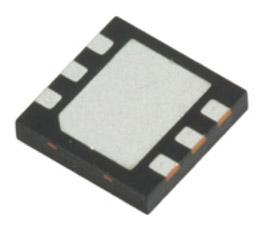
Ruggedness: Supercaps tend to degrade more quickly at higher temperatures, compared to batteries. Typically, they are specified up to +70°C, and while many batteries are specified only up to +60°C, you can find batteries which are fully characterized to +85°C.
Load transient performance: Supercaps are much better than batteries at handling current surges, but their output drops off rapidly with load.
Lifetime: Supercaps have relatively high internal self-discharge, so even if they are not used, there will be loss of stored energy. Depending on model, they can discharge through this leakage in about a month, and so need frequent replenishment. In contrast, battery self-discharge is on the order of 10 percent a year.
Cost: Batteries tend to be more costly than supercaps, although many factors are involved in making a fair comparison.
Good engineering practice is to be open-minded about solutions. In this regard, even if you are looking at energy harvesting as a very-long term power and energy source by using supercapacitors, rechargeable batteries, or both, ask yourself what your actually mandated product lifetime really is.
Based on the answer, do not rule out supplementing these energy-storage elements with a conventional, non-rechargeable coin cell such as the ubiquitous CR2032. This type of cell has a shelf life of more than ten years at low current drain, and may be just the right add-on to overcome the weaknesses of the supercap or rechargeable battery. Very few products have to last "forever"; ten years of trouble-free performance may be very achievable with the addition of a small, non-chargeable energy-storage element, and at lower overall cost.
Summary
A compete energy-harvesting subsystem requires source, a storage element, and a management of the sourcing side, storage, and load power drain. There are two practical energy-storage components: batteries of various chemistries and supercapacitors (also called ultracapacitors). This article looks at the basic characteristics of each for harvesting applications, in terms of capacity, charging, supplying load transients, long-term availability, and cost. As a result, designers will understand the issues and trade-offs when deciding which one they should use—or perhaps decide to use both, in combination.
Additional reading
- TechZone article “Managing the Energy and Lifetimes of Thin-Film Batteries,”
- TechZone article” Storage Alternatives for Energy Harvesting Applications,”
- "Energy Harvesting: Positive adoption trends expected to double the market within 5 years,"
- "Energy harvesters challenge batteries in wireless sensors,"
면책 조항: 이 웹 사이트에서 여러 작성자 및/또는 포럼 참가자가 명시한 의견, 생각 및 견해는 DigiKey의 의견, 생각 및 견해 또는 DigiKey의 공식 정책과 관련이 없습니다.









 대한민국
대한민국